

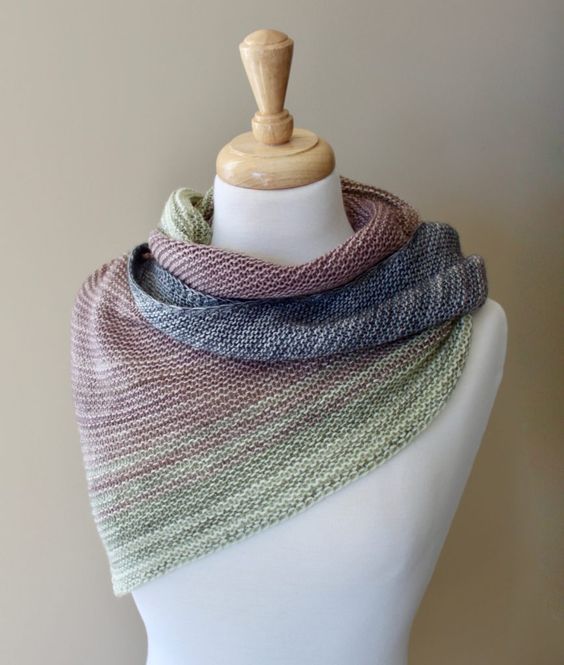
Cozy Fusion Knitted Blended Shawl — Triangle Pattern for Leftover Fingering Yarns
This Cozy Fusion Shawl is a triangular, blended-color shawl worked from a single cast-on stitch and increased across alternating rows to form a gentle triangle. It uses leftover fingering-weight yarns and a simple garter-stitch fabric, with a repeating colour-blending routine to create soft transitions. The pattern highlights easy shaping and flexible sizing—ideal for using scraps and experimenting with colour.
Below you'll find materials, gauge, finished measurements, stitch glossary, the full stitch-by-stitch instructions, the blending technique used for colour transitions, and finishing notes. The shawl is worked flat; a circular needle is handy for the large number of stitches.
Materials
- Multiple colours of leftover fingering weight yarn in varying amounts.
- US size 6 [4.0 mm] needles, or size needed to obtain desired gauge. The shawl is worked flat but a circular needle is useful for the large number of stitches.
- Blocking materials.
Gauge
- Gauge will vary. It isn’t necessary to match my gauge. But for reference, my average gauge is 18 sts and 34 rows = 4 inches [10 cm] in garter stitch, after blocking.
Finished Measurements
- Finished measurements will vary. For reference, my finished shawl is approximately 18 inches [46 cm] deep at middle point and 58 inches [147 cm] long across top edge, blocked.
Stitches Used
- k – knit
- p – purl
- sl – slip the stitch from left to right needle as if to knit, with yarn in back
- kfb – knit into the front and then the back of the stitch (increase)
- k2tog – knit 2 stitches together (decrease)
Instructions
Cast on 1 stitch. Work Rows 1 to 7. All slipped stitches are slipped kwise wyib.
Row 1 (WS): Kfb – 2 sts.
Row 2 (RS): K1, kfb – 3 sts.
Row 3: Sl1, k1, kfb – 4 sts.
Row 4: Sl1, k1, kfb, p1 – 5 sts.
Row 5: Sl1, k2tog, kfb, p1 – 5 sts.
Row 6: Sl1, k1, kfb, k1, p1 – 6 sts.
Row 7: Sl1, k2tog, kfb, k1, p1 – 6 sts.
Next, work Rows 8 and 9 until end of shawl (one stitch increased for each repeat), changing colours with the blending technique explained below.
Remember to work edge and increase stitches loosely so that the edge of the shawl stretches nicely during blocking.
Row 8 (RS): Sl1, k1, kfb, k to last st, p1.
Row 9 (WS): Sl1, k1, k2tog, k to last 3 sts, kfb, k1, p1.
Blending Technique
When you are ready to change yarns, leave enough working yarn to continue using it for 8 more rows, or 4 repeats of Rows 8 and 9 (see note below). After completing a WS row (Row 9) drop your working (old) colour. Pick up new colour and work Rows 8 and 9. Drop new colour and pick up old colour. Work Rows 8 and 9 twice. Drop old colour. Pick up new colour and work Rows 8 and 9 twice. Drop new colour, pick up old colour and work Rows 8 and 9 once. Drop old colour and continue with new colour. Repeat this technique at the next and all subsequent colour changes.
Note: Estimating how much yarn is needed for blending can be tricky. Pay attention to how much yarn you are using per row right before the change so you know approximately how much will be required. My amounts will not be the same for your shawl, but for reference, my colour changes ranged from 275 feet for the first one to 600 feet for the last one.
Finishing
Bind off all sts. Weave in all ends. Wash and block.
Quick Tips
- Weave in ends as you go or trim and weave them after blocking—choose what works best for your workflow.
- Use a circular needle with ample cable length so stitches sit comfortably while you increase to a large stitch count.
- Block the shawl gently to open the garter texture and smooth colour transitions; working the edge and increase stitches loosely will help the border lie flat.